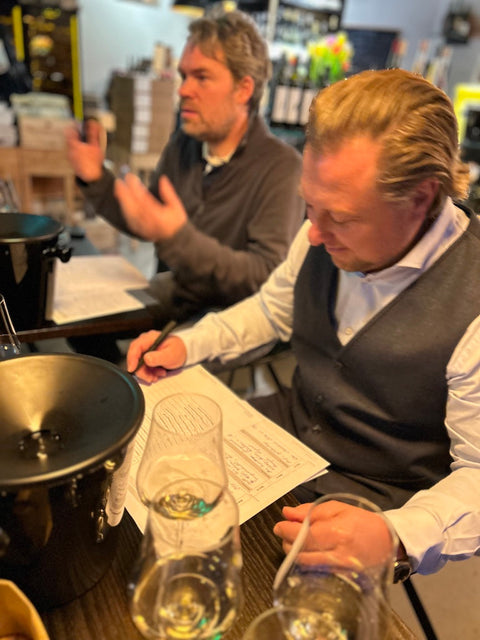
Our wine enthusiast and fellow Weinakademiker Florian Hopf has specialized entirely in Burgundy varieties. Chardonnay from Germany, in particular, offers excellent conditions for high quality due to the many limestone-rich soils and the northern climate. After Florian had already explored this topic at several events for the Weinakademiker Club, and ultimately also with winemakers in Germany, the next logical step was to take a look at Austria.
The landscape is dominated by shell limestone, Pannonian Leithakalk, slate, gneiss, and other sedimentary rocks—which pose challenges for Chardonnay—as well as a conglomerate of all these combined with Lower Austrian primary rock.
The hot temperatures—especially the Pannonian climate in the east—can be "strenuous" for Chardonnay. Yellow-fruited, ripe to overripe aromas were noted, as well as alcoholic nuances on the finish and an occasional sharp acidity that, especially in its youth, does not come across as elegant or drinkable. A positive note was the sparing use of reduction and the refusal to "follow the herd" of a global trend toward uniform taste. The origins—reduced to the regions themselves—are clearly recognizable. As for the individual sites, we in the west likely lack the training and engagement with the new sub-vineyard designations used by some winemakers. A new site classification is also on the way, and we are curious about its implementation. As is well known, a tasting is always just a snapshot, and the wines were predominantly very young. In an international price comparison, Austria's premier league remains very affordable. Only one wine exceeded the €100 mark—why was unclear to us, especially as it did not manage to secure a spot in the top 5 on the podium.
An unexpected surprise was the refined and vinified 2022 Reserve from the Bründlmayer winery.
That the Morillon Obegg 2021 from the Trummer am Obegg winery is right up there at the top came as no surprise to us at Weinstein.
Other favorites included the Ried Tatschler from Andi Kollwentz, Ried Pössnitzberg Alte Reben from Erwin Sabathi, and Ried Altenberg from Paul Achs.