The following blog post is a summary of the lecture given by Prof. Dr. Hannes Schultz (Geisenheim University):
“Climate change in viticulture and what we can do about it”
As part of the annual graduation ceremony of the Austrian Wine Academy, masterclasses with leading experts in the wine industry were held again this year. One of the highlights was the lecture by the soon-to-retire Prof. Dr. Hannes Schultz from Geisenheim University, who addressed the impact of climate change on viticulture and adaptation strategies for the future.
Soil as the key to sustainability
“Soil is the key to sustainability” was one of the core messages of Schultz’s lecture. He stated that soil is the foundation of sustainable viticulture: it stores water, nutrients, and carbon, thus forming the basis for healthy vines and stable ecosystems. Soil organic carbon (SOC) in particular plays a crucial role, as it is responsible for evaporation and water retention.
Global climate change and CO₂ dynamics
According to Schultz, CO₂ concentration is particularly high in the Northern Hemisphere—precisely where viticulture takes place between the 30th and 50th parallels. This is confirmed by Friedlingstein’s “Global Fossil CO₂ Emissions Report”.
CO₂ is significant because it has a long residence time of 20 to 50 years in the atmosphere. He referred to studies from Geisenheim showing that increased CO₂ levels (eCO₂) affect not only the growth behavior of vines but also the size of insect populations.
Rising temperatures and climatic shifts
“Warming has occurred in all regions” – this warming affects all wine-growing regions worldwide. Since 1980, a so-called “global brightening period” has been observed, representing an increase in solar radiation.
After the Second World War, temperatures briefly declined, which was attributed to a “polluted atmosphere” caused by aerosols. Today, the air is cleaner—and as a result, temperatures are rising faster.
The consequences for viticulture are serious:
-
Higher temperatures lead to a higher pH level in wines and increase the risk of microbial spoilage.
-
There is a reduction in anthocyanins, the pigments in red wines.
-
Shifts in grape varieties are inevitable: some traditional varieties are reaching their limits, while new or warmer-climate varieties offer opportunities.
-
New wine regions are also benefiting: more northern zones are becoming increasingly relevant.
Extreme weather events as the greatest challenge
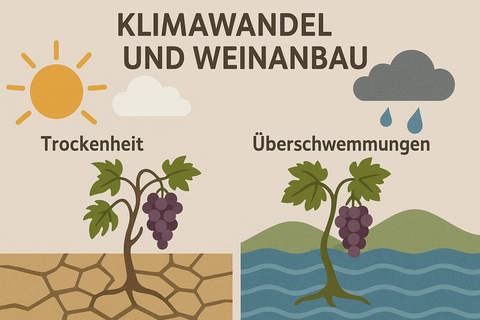
Of particular concern, according to Schultz, is the rise in sea levels and the warming of the sea surface by 1°C, which increases evaporation by around 7%. This corresponds to about 35,000 km³ of additional water in the atmosphere.
“What goes up, must come down,” Schultz warned—falling back to Earth in the form of heavy and unpredictable precipitation. As a result, flooding, erosion, and heavy rainfall are increasing significantly.
Adaptation strategies in viticulture
Schultz identified the most important measures:
-
Soil and cover crop management: Targeted cover cropping and diverse plant mixtures can stabilize the soil and improve water retention.
-
Return to traditional training systems: Systems such as Gobelet (bush vines) provide protection against heat stress through natural shading. They are more labor-intensive but more climate-resilient than mechanized systems.
-
Pruning and canopy management: Targeted pruning measures can slow down the ripening process of the grapes to maintain the balance between sugar and acidity.
Conclusion
Prof. Schultz concluded with an optimistic appeal:
“We are not a coral reef – we can adapt.”