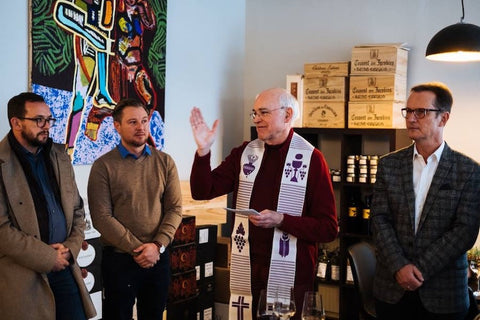
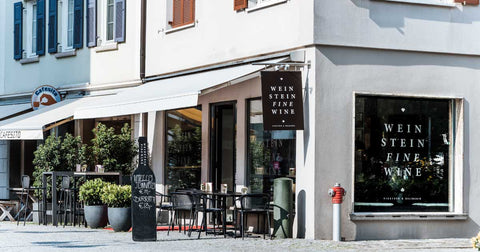
When winemakers visit each other, it is never just about wine. It is about origin, climate, and the question of how style is formed. When Grabenwerkstatt was hosted by Kurek's wine bar Pi in Nonnenhorn, exactly this dialogue became tangible – between Lake Constance and the Wachau, between water and rock, between the present and tradition.
Climate as a Question of Character
Lake Constance is not a marginal note in the glass. With around 1,200 mm of precipitation or more per year, it has a massive impact on its surroundings. Lush vegetation, juicy soils, long ripening periods – the climate is mild but humid.
The Wachau, on the other hand, manages with an average of about half that amount of precipitation. Drier conditions, barren soils, significant temperature differences between day and night. Two extremes – and it is precisely from this that two very different signatures emerge.
Framed by a classic Heurigen snack – bread, bacon, cheese, Liptauer, pickled vegetables – this climatic contrast was made perceptible to the senses.
Wachau as Imagined in the Past
The style of Grabenwerkstatt is deliberately not a loud one. Rather, it is oriented toward a Wachau as many describe it from the 1970s: straightforward, cool, precise, without the influence of botrytis, with moderate alcohol and clear evidence of origin.
The more opulent, powerful style of the 1990s, which made the Wachau internationally famous – ripe, dense, with sometimes noticeable noble rot and high extraction – is historically not the "old" style, but rather a phase of modernization and market adaptation. After the wine scandal of 1985, one simply had to make oneself noticed. Lush wines with alcohol and sometimes significant oak were a logical reaction by the winemakers to this challenge.
Grabenwerkstatt sees itself more as a return to roots: tension instead of impact, minerality instead of opulence.
Vintage Depth in the Glass
The opening act was the Wachauwerk Grüner Veltliner 2021 – taut, spicy, clearly defined.
The Schön Grüner Veltliner Smaragd 2020 (still under the former Smaragd classification) showed ripeness and pressure without losing its cool line. Beside it, the Ried Schön Grüner Veltliner 2021, more focused, salty, with fine phenolics.
Among the Rieslings, the terroir signature became particularly clear:
The Kalkofen Riesling Smaragd 2020 with depth and structure, the Ried Kalkofen Riesling 2021 more precise and stony.
With Ried Trenning Riesling 2023 and Ried Bruck Riesling 2023, the arc was drawn to the young vintages – crystalline, vibrant, with that cool clarity that hints at their aging potential. Great wines on both sides of the glass.
Especially in the comparison of matured and current vintages, it became clear: these wines are not meant for immediate consumption, but need time to fully unfold.
Lake Constance as a Resonant Space
From the host side, Jonas Kurek brought two wines into play:
The Nonnenhorner Blanc 2024 – fresh, juicy, shaped by the water-rich climate.
The Sonnenbichl Chardonnay 2023 – structured, with a fine note of oak and balance between power and elegance.
Here the difference was particularly palpable: while the Wachau works with dryness and barren tension, Lake Constance provides different conditions with its high precipitation – more juiciness, a different texture, a form of expansiveness all its own.
Exchange Instead of Staging
Such evenings are not a show. They are workshop discussions. There is debate about harvest times, physiological ripeness, alcohol levels, and market mechanisms. About tradition – and about what "original" actually means.
Between the Wachau and Lake Constance, a competition did not emerge, but rather a dialogue. Two regions, two climates, two styles – connected by the same aspiration: to bring origin into the glass.
All tasted wines from Jonas Kurek and Grabenwerkstatt are available in the Weinstein Finewine online shop. Those who would like to experience the difference between 1,200 millimeters of precipitation and stony dryness for themselves will find the perfect opportunity there.