Proper decanting and aerating can significantly influence a wine’s aromatics—provided you know what you are doing. Not every wine benefits from contact with oxygen to the same degree. While young, powerful red wines gain expression through aeration, older, matured wines require particularly gentle handling. But what exactly is the difference between decanting and aerating—and when is which approach appropriate?
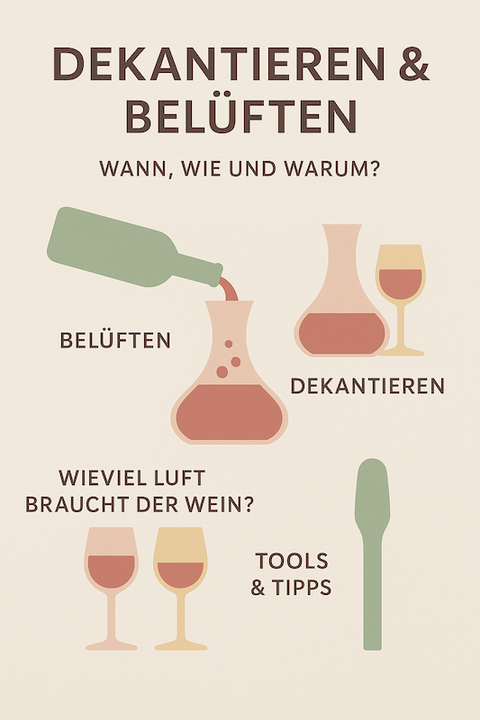
Aerating is about introducing oxygen to the wine. Young red wines, especially dense, structured examples with high tannin content, open up through contact with air. By pouring them into a carafe—or even vigorously swirling them in the glass—primary fruit aromas are better highlighted, and rough edges are smoothed out. Some white wines, such as complex Burgundies or aged natural wines, also benefit from this measure.
Decanting serves primarily to separate the wine from the sediment—the natural deposits that form in the bottle as it ages. The focus here is not on aeration, but on clear enjoyment without particles. Particularly with mature red wines—such as older Bordeaux or Barolo—careful decanting with the help of a candle or light source is recommended to detect the sediment in the bottle neck early. The rule here: as little movement as possible and no excessive air exposure.
The rule of thumb: the younger and more powerful the wine, the more air it can handle. Some wines even continue to develop in the decanter over several hours. Older or particularly fragile wines, however, can oxidize after just a few minutes—caution and experience are valuable here. In case of doubt, a “glass comparison” is recommended: one portion stays in the bottle, the other is decanted—this allows you to discover the optimal drinking state.
Decanting and aerating are tools for developing wine—not mandatory exercises. Depending on the grape variety, style, and age, the right technique can significantly improve the taste experience. At Weinstein Finewine, we are happy to advise you on which wines “need air”—and which belong directly in the glass.