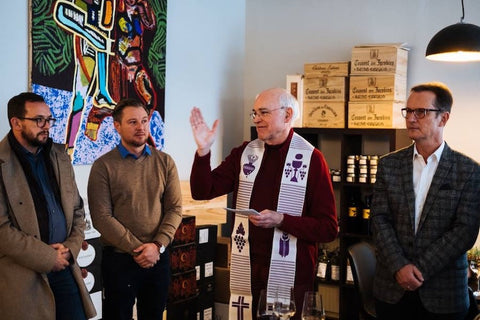
In mid-July, this year's Weinstein-Finewine trip took us to Bordeaux. Nine wine enthusiasts, two intense days in the vineyards, and a mix of big names, excellent tastings, long dinners, and the best of moods.
The first day was dedicated to the Left Bank. In the Médoc, we visited Château Branaire-Ducru in Saint-Julien, Château Phélan Ségur in Saint-Estèphe, and Château Pontet-Canet in Pauillac, Château Léoville Poyferré in St. Julien, and finally Château du Tertre in Margaux. In their orangery (a type of greenhouse by the swimming pool used for events), we were able to wind down a long day with a magnificent dinner accompanied by the perfect wines.
The next morning, we crossed over to the Right Bank. The day began with Château Ausone, one of the great legends of Saint-Émilion. This was followed by Château Daugay, Château Figeac, and Château Nénin in Pomerol, where we were also able to taste other wines from the Delon family portfolio – including Léoville Las Cases and Potensac. In between, there was time for a stroll through Saint-Émilion and a quick lunch featuring the legendary foie gras burger known in our circles. Another excellent dinner at Restaurant Luna provided the perfect conclusion to our Bordeaux wine trip.

Bordeaux 2026: Heat, Drought, and Major Differences
Alongside the wines, the condition of the vineyards was a central topic. The summer of 2026 has been marked by exceptionally high temperatures across all of Europe. In the Médoc, in particular, drought and heat stress were clearly visible. While the deep gravel soils provide excellent drainage, they can barely store water. In some places, little progress in vegetation was visible because the vines reduce their activity during extreme drought.
In Saint-Émilion, the picture was different. The limestone and clay-limestone soils function like a natural water reservoir. The porous limestone absorbs moisture and gradually releases it back to the vines. This difference is becoming increasingly important, especially in hot and dry years.
Just how serious the climatic situation has become was demonstrated immediately after our departure: only two days later, Bordeaux-Mérignac airport had to temporarily close due to heavy smoke from forest fires. While the vineyards in the Médoc and Saint-Émilion were not directly affected by the fires, heat, water shortages, and increasing weather extremes are presenting Bordeaux with major challenges.
Our trip therefore offered more than just great wines and special encounters. It also impressively demonstrated how much terroir, soil, and water supply determine the future of viticulture.